

Our Impact
Battery repair reduces lifecycle emissions by 89%. Discover the strategic environmental advantages of circularity compared to conventional replacement.
→ IMPACT POWERED BY ESG
Since 2020, NOWOS has transitioned from a specialized service provider to a cornerstone of the European battery value chain.
By prioritizing Repair-over-Replacement, we enable a circular lifecycle for lithium-ion assets, significantly reducing environmental degradation while optimizing capital expenditure for global mobility and energy leaders.


“Without them [NOWOS], broken batteries would either be thrown away under warranty or end up in a landfill when out of warranty. Instead, together we’ve given thousands of batteries a second life, extending their use and preventing unnecessary waste. This collaboration is a great example of how working with the right partners can create real impact.” - Swapfiets

Operational Impact: Industrial-Scale Repair
NOWOS operates at the intersection of high-tech diagnostics and industrial-scale repair. We don't just recirculate; we restore value.
Repairability Success Rate
Repair is proven. 89% of all incoming batteries are successfully repaired and returned to service (2024/2025).
89 %
120k
Industrial Capacity
Industrial-scale repair is already here. With a planned expansion of 100.000 units in extra capacity in 2026, we are ready to work on a large scale to meet demand for the energy transition.
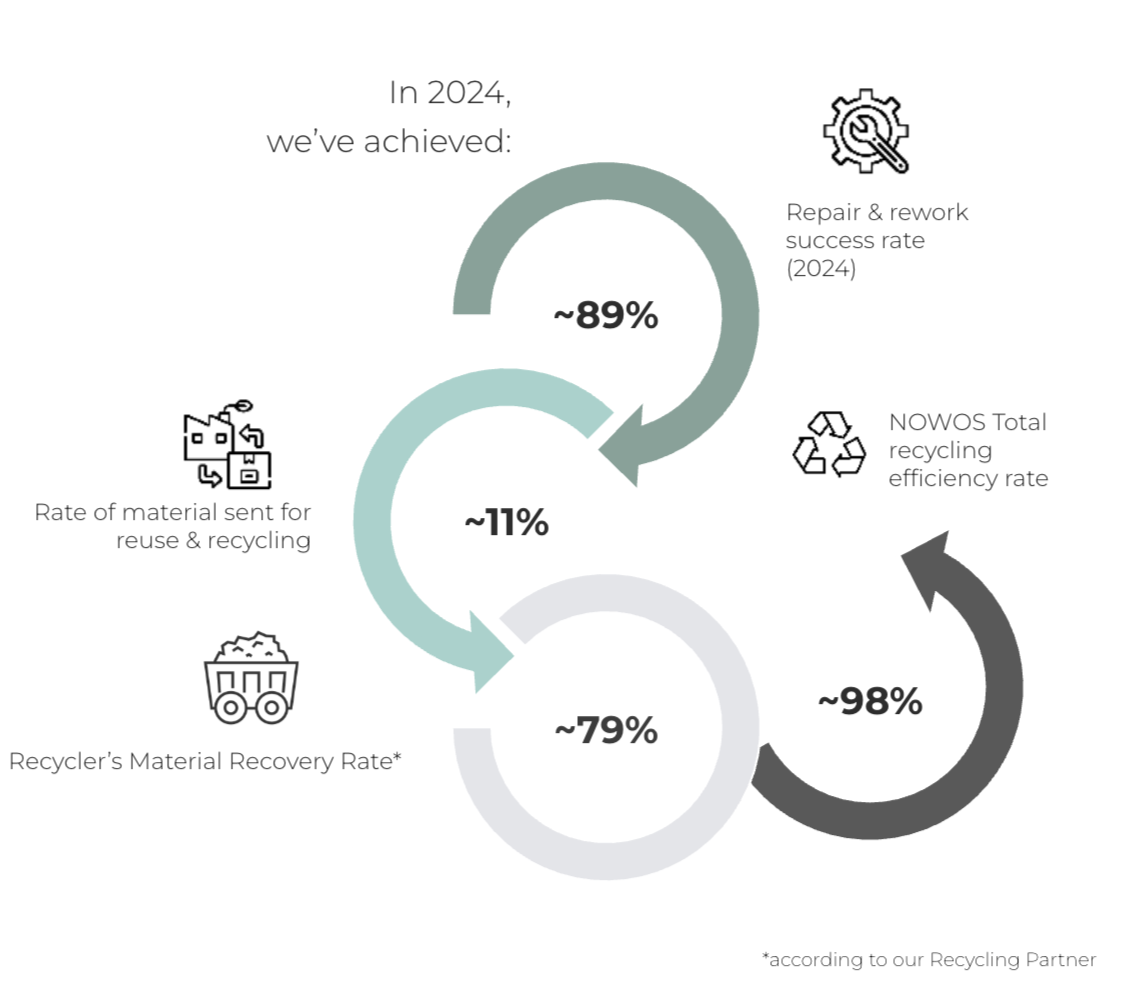
→ The remaining 11% are dismantled for the reuse of parts and recycling.
Through our recycling partner, which achieves a 79% material recovery rate, we reach an overall 98% Total Recycling Efficiency rate, meaning the total recovered materials during the recycling process for these end-of-life batteries.
The Road to 100%
Driven by "Right to Repair" legislation and the EU Battery Regulation, we are gaining previously blocked access to proprietary diagnostics and spare parts from battery manufacturers, which will increase repairability rates.
We project repairability rates may reach 95-98% by mid-2027, thanks to regulations and collaborative manufacturers, and 100% by 2030.
Environmental Preservation: Measurable Decarbonization

→ CARBON AVOIDANCE
We monitor greenhouse gas emissions avoided by repairing batteries instead of manufacturing new ones.
2,210 Tonnes of CO2e
Avoided by NOWOS in 2025
This is the equivalent of the total annual CO2e from producing energy for 280 Dutch homes, or 1,500 round-trip flights from London to New York for one passenger.
Circularity Score: A repaired battery is 2.28x more circular than a standard replacement.
GHG Reduction: Our process offers an 87-89% reduction in emissions compared to new manufacturing.
Unit Impact: Repairing a battery costs the planet only 10-13 kgCO2e, versus 105 kgCO2e for a new unit.
Source: Rainbow Standard Methodology
→ MATERIAL AVOIDANCE
We prevent the "Carbon Debt" of new mining by extending the life of existing minerals.

173 tons
Critical & Strategic Raw Materials (Lithium, Cobalt, Nickel) were saved from virgin mining in 2025, including :
3,500 tons of battery-grade lithium
5,833 tons of cobalt
17,499 tons of battery-grade nickel
We measure the weight of refined critical and strategic raw materials (e.g., lithium, cobalt, nickel) contained in serviced batteries and whose life has been extended via our services and/or recirculated for recycling, thus reducing new production with virgin resources.
Our calculation methodologies are backed by sources from the Global Battery Alliance, EIT Urban Mobility, the Rainbow Standard Methodology, the Journal of Power, CBS, RTE, International Council on Clean Transportation, the German Engineering Federal and the EU Critical Raw Materials Act.

Energy Conservation: Saving the Grid
We track Preserved Battery Capacity, the total MWh diverted from premature recycling.
47 MWh
Preserved Battery capacity
from NOWOS activity in 2025.
The equivalent of powering 20 Dutch households for an entire year
or 94,000 e-bike batteries.
Our impact is financial
55%
Total Cost of Ownership
Reduced by Repairing vs Replacing with New
Sustainability is a financial lever. By extending asset life by 2–5 years, we fundamentally improve the Total Cost of Ownership (TCO), transforming battery life extension from a sustainability initiative into a core financial lever.
→ CASE STUDY: micro mobility fleet operators
CapEx to OpEx : We convert €550 replacement costs into sub-€100 repairs, cutting asset spend by 55%.
Stretch Your Investment: Extend battery life from 2 to 5 years. Lower annual depreciation and boost net profit margins.
Regulatory Resilience: An 89% repair rate eliminates expensive recycling fees and ensures "Right to Repair" compliance.
Residual Value: Digital Battery Passports transform "scrap" into bankable assets for second-life energy storage.
Customer Retention: Affordable repairs prevent brand abandonment, maximizing Customer Lifetime Value (CLV).
Monitored UN SDG cobenefits




Our Corporate Social Responsibility Framework
Governance & Ethics
Strategic Oversight
Our operations are overseen by a dedicated Supervisory Board, which provides strategic guidance and ensures the highest level of accountability across the organization.
Stakeholder Engagement
We maintain transparency and foster open dialogue with our financial partners through regular investor and shareholder meetings, where we discuss our strategy, performance, and long-term impact.
Ethical Operations
Our day-to-day business is guided by a formal Code of Conduct.
Our People
The health and safety of our team is paramount, managed through a formal Health & Safety policy and a comprehensive risk assessment framework.
We champion a diverse and inclusive workplace with formal policies against discrimination and for the employment of persons with disabilities.
We invest in our team's potential through structured professional training.
Environment Management
To ensure continuous improvement, we are on track to calculate our carbon emissions emitted and avoided for the third year in a row, thanks to a collaboration with Via-ID’s impact program. The avoided emissions are calculated each year using Carbone4’s Net Zero Initiative methodology.
In 2025, we launched a process with The Rainbow Standard to assess our product’s footprint and avoidance with an extensive Life Cycle Analysis.
Read further about this below.
Notification on Carbon Accounting
A Note on Emission Credits
As in our Terms & Conditions, emission credits associated with products repaired or serviced by NOWOS have already been registered by NOWOS as part of a certified climate protection project in the Rainbow Registry (Project ID: RIV-2025-PROJ-123 and Project ID: RIV-2025-PROJ-124). These emission credits relate exclusively to the CO₂ reductions achieved through the repair and lifetime extension services for batteries performed by NOWOS and cannot be claimed or issued again by the client.
More about the Rainbow Standard


-
While your company receives the direct environmental benefit of the repair, the carbon credits are registered to the NOWOS Repair Center Expansion Project (Project ID: RIV-2025-PROJ-123 and 124). This follows the Rainbow Methodology, where credits are issued to the infrastructure that enables the emission reduction, in this case, our repair center, rather than the individual product being serviced.
-
This question highlights the important difference between a product and a project in the voluntary carbon market.
Here’s a simple breakdown:
Credits are Awarded to the Project, Not the Product. In the voluntary carbon market, credits are not tied to an individual product (like your battery). They are awarded to the certified project that makes the emissions reduction possible. Under the Riverse methodology (Project ID: RIV-2025-PROJ-123 and 124), our advanced repair facility is the project.
Credits Incentivize the Solution. The goal of this system is to incentivize and fund the creation of specialized facilities like ours. These facilities are the true bottleneck in creating a circular economy, and the carbon credits help us build and scale this vital work.
You Receive a Different, Powerful Value. Your company receives a direct and significant benefit: measurable Scope 3 emissions reductions. By choosing to repair rather than replace, you get to claim these reductions on your own environmental ledger, which is a powerful asset for your company's sustainability goals and reporting.
-
That's a common comparison, but it's actually a different system. Tesla's credits (in that example) often come from a compliance market (like California's), which operates under different, government-mandated rules. We operate in the global voluntary carbon market, where the rules are designed to fund specific, registered projects like our repair facility. The analogy isn't relevant here.
-
You could, but it's important to understand what that entails. To claim carbon credits, you would need to become a certified project operator yourself.
This involves:
Operating your own industrial repair facility.
Complying with the full, complex Rainbow methodology.
Implementing rigorous data monitoring and tracking.
Undergoing (and paying for) regular, independent third-party audits.
Managing the official registration and issuance process.
This requires significant technical and operational investment.
Our service allows you to gain the core environmental benefit (your Scope 3 reductions) without taking on this complexity. It is therefore fair, and standard practice, for NOWOS as the entity enabling and executing the project to retain the credits.